

Fun Palaces producer Rachel spent a day with Hastings Commons – here’s what she brought back about everyday culture, shared spaces and who gets to shape a place.
Recently I attended Hosting the Commons, a day exploring Hastings Commons and its work across the town, led by Jess Steele, who has been developing the project since 2014.
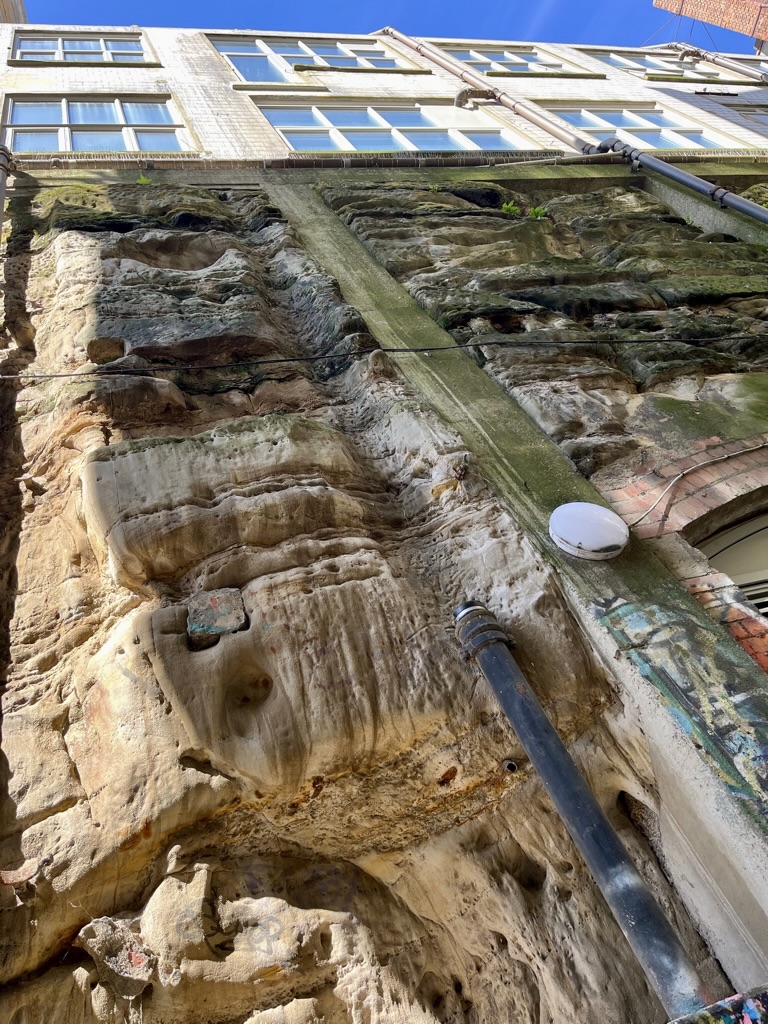
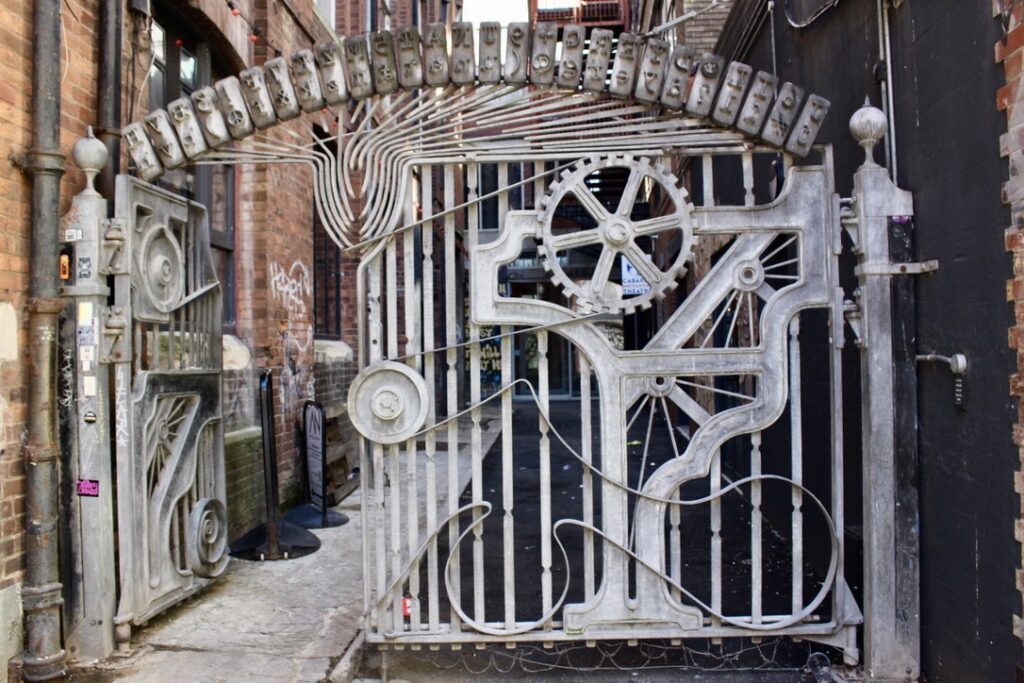
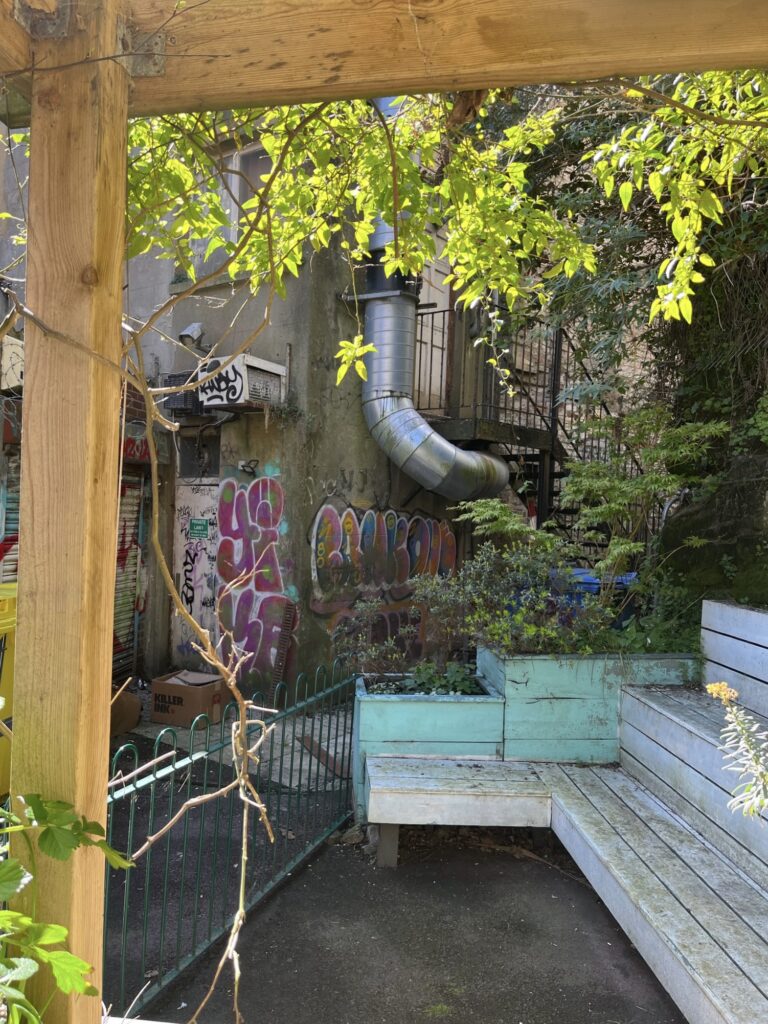
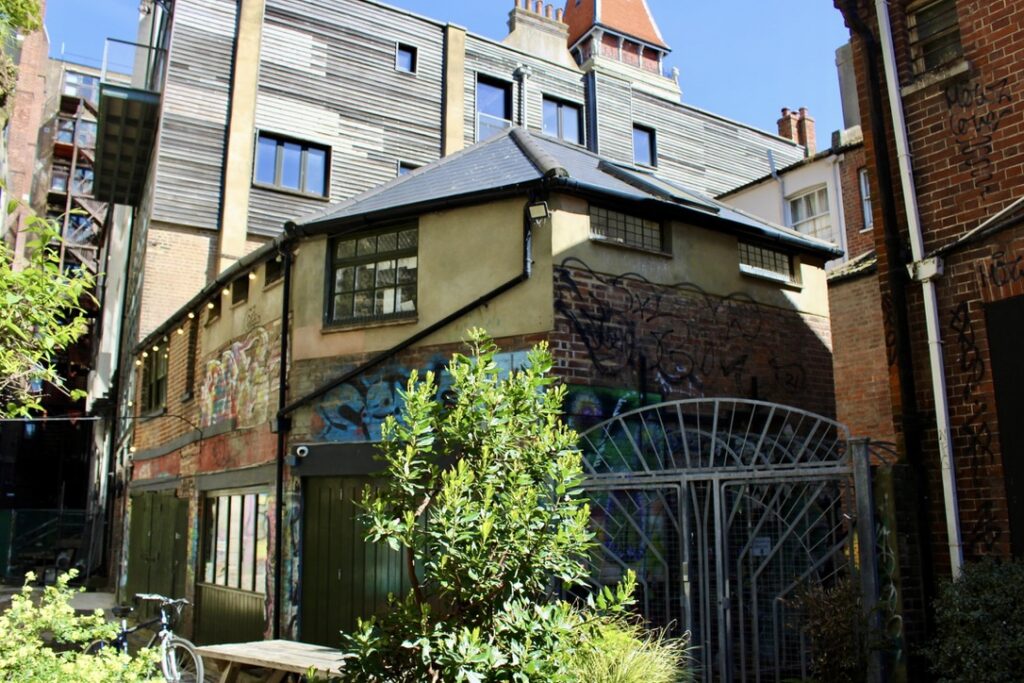
The day began in the alley, a tucked-away space behind 12 Claremont between the sandstone cliffs. It is the kind of place easily missed unless you are curious enough to explore the many hidden alleyways of Hastings. Jess asked us to pause and take in the space. The rock face rises behind the buildings, some cut directly into it, while archways offer shelter with tables where we later sat during lunch. When we stood there, it was warm and sunny and felt quiet, held slightly apart from everything else.
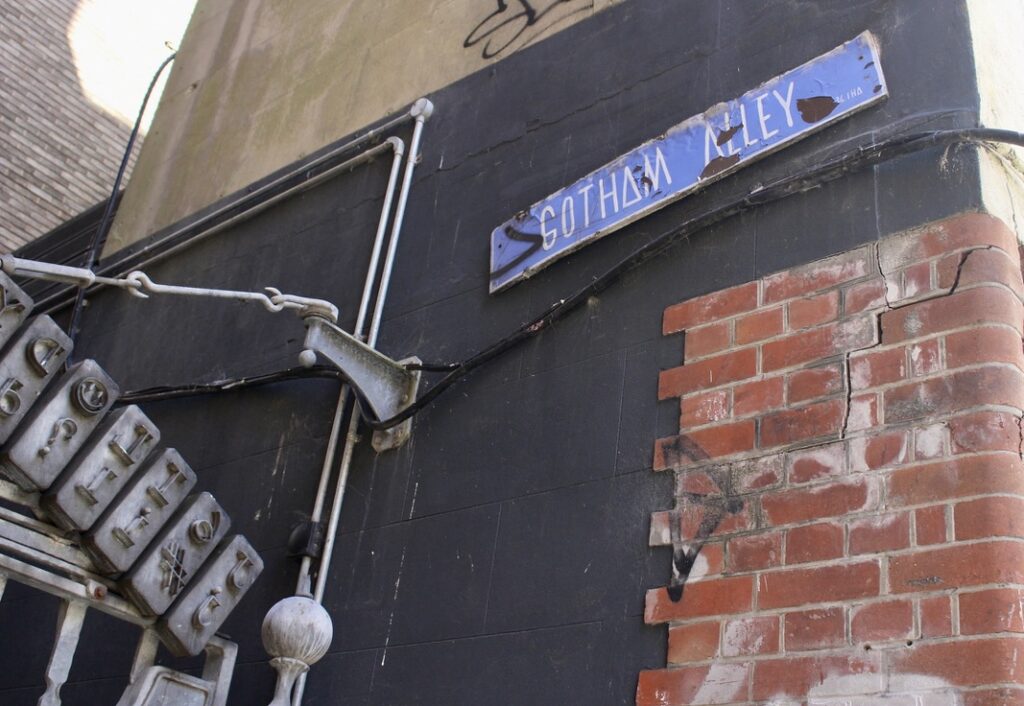
For many years this alleyway had become a neglected and forgotten space – somewhere overlooked, under-cared-for and often perceived as unsafe. But the revitalisation of the space shifts something. When people return to a place, spend time in it and care for it, the space begins to give something back. It can become more welcoming and revitalised, encouraging new interactions between people, nature and the space itself. In turn, the space begins to feel safer through people’s presence, care and everyday use. This is not only about financial value, but social value: the reciprocal relationship between people and place. The soft sandstone bears marks shaped by generations of activity, continually remade through use and care.
The alley seemed to reflect a wider idea around the commons: that places are continually made and remade through use. This felt significant because it reflected something wider in what Hastings Commons is attempting to do with buildings across the town. The work is not only about restoring neglected spaces, but about creating the conditions for places to become useful, meaningful and shared again. That feels closely connected to everyday culture. Culture does not appear because an organisation programmes it into a building. It emerges when people have the permission, confidence and connection to use places, shape them, remember them and make them part of their lives.
During the day we moved between several Hastings Commons sites, each operating slightly differently but connected through shared ideas around stewardship, participation and long-term community use. We began at 12 Claremont, before later visiting the Observer Building, where Hastings Commons offices now sit alongside workspaces, public areas and the rooftop Observatory Bar. Seeing these spaces together made Hastings Commons feel less like a single project and more like a connected network of places trying to hold buildings differently.
When we left the Observer Building and stepped onto Cambridge Road, Jess pointed down Bassey Steps towards the area once known as the America Ground and shared the well-known Hastings story of how changes to the shoreline created land that sat outside clear systems of ownership. During the early nineteenth century, people built homes, workshops and livelihoods there, forming a self-organised community for several decades before the land was eventually claimed by the Crown and many residents displaced. There was a clear connection between those histories, particularly how spaces are shaped through use rather than design – a reminder that places only become meaningful because people inhabit them.
This history feels closely connected to the idea of the commons and to Community Land Trusts more broadly: not ownership as extraction or investment, but stewardship rooted in long-term use, participation and collective benefit. It raises a quieter question underneath everything else: what does it actually mean for land or space to be shared – and who gets to decide that?
Land Trusts such as Hastings Commons attempt to remove buildings from speculative markets and hold them for long-term community benefit. But they still have to operate within systems built around ownership, debt, rising land values and private property. Discussions throughout the day touched repeatedly on risk, finance and power – questions about who ultimately holds control, and how systems designed around extraction might instead be repurposed towards collective benefit.
Writing about Amanda Huron’s Carving Out the Commons, Alexis Zanghi argues that commoning is not a utopian escape from capitalism, but “a pragmatic practice in the face of crisis.” This frames commoning not as a way of escaping difficult systems altogether, but as a practical way to organise, care for and hold shared resources within them. Commons do not sit outside systems of property, finance and inequality – they exist in tension with them. They are shaped by contradictions: dependent on labour that is often invisible or undervalued, vulnerable to exclusion, and always at risk of being reabsorbed back into market structures. In a time marked by housing insecurity, privatisation and the erosion of civic infrastructure, projects such as Hastings Commons raise questions about whether forms of collective stewardship might offer what Zanghi describes as a “third way” between the market and the state.
One moment during the day particularly highlighted how the physical qualities of a space shape behaviour. When everyone entered an unfinished room, people almost instinctively lowered their voices. Conversation became quieter without anyone consciously deciding to do so. It was a small moment, but it revealed how much atmosphere, behaviour and belonging are shaped by space. If a room can make us lower our voices without thinking, then spaces can also quietly signal who belongs, who feels comfortable, and who feels able to take part.
And that raises further questions: if spaces are intended to be shared, how do people recognise that they are for them? Jess spoke openly about some of the challenges, including communication and visibility. And this matters, because spaces can remain open whilst still feeling inaccessible in practice. There can still be an assumption that people will step forward if they want to be involved – as members, commoners, organisers or users of the space. But stepping forward can be difficult. It often depends on confidence, time, existing relationships, and feeling that the space is for you. In that sense, participation can still move through existing networks, even within projects deeply committed to doing things differently.
Later in the day we visited Eagle House, home to a Camarados Public Living Room – a shared space shaped through what people themselves want or need from it. Whilst sitting together over cake, Jess described how a group of older residents had mentioned wanting somewhere to dance and how something had since been organised in response. It was a small example, but an important one. The space could evolve through use, participation and conversation. That stayed with me afterwards.
This is also where the connection between Fun Palaces and Hastings Commons feels particularly strong. Their Alley Way Learning programme is rooted in the idea that local people have knowledge, skills, stories and passions to share with one another. That reciprocal exchange – giving, receiving, learning, offering and connecting – feels closely aligned with Fun Palaces’ belief that culture already exists within people’s everyday lives. Our upcoming Bring and Share session at the Skill Share Social Open Day on Saturday 30 May grows from that shared understanding: that culture and commoning both begin with what people bring, what they share, and what becomes possible when others are invited in.
Spending time at Hastings Commons highlighted the kinds of conditions everyday culture needs in order to thrive. Not simply access to buildings. Not simply participation in activity. But places where people feel some sense of agency, responsibility and connection. Places where people do not simply consume culture, but help shape the spaces and relationships culture grows within.
Commoning and everyday culture are not separate ideas. Both are shaped through use, care, participation and connection to place – through the ways people gather, respond, make meaning and build relationships over time. They are not finished structures or perfect models, but ongoing practices of collective life.
We’d love you to join us on Saturday 30 May at the Observer Building for Fun Palaces – Bring and Share, and to continue the conversation around everyday culture, shared spaces and the small acts of participation that help shape place.
You are invited to join the Fun Palaces Bring and Share event
at the Hastings Alley Way Learning Skill Sharing Launch!
Saturday 30 May 2026, 11am-3pm
Observer Building, Hastings Commons
53 Cambridge Road, Hastings, TN34 1DT
Nearest station: Hastings
Free to take part, no need to book – just drop in on the day